
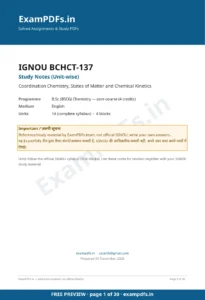
📘 BCHCT-137 Notes🌐 English Medium📚 14 Units⚡ Instant Download
BCHCT-137 Notes – IGNOU Study Notes (English Medium)
BCHCT-137 Notes — IGNOU BCHCT-137 (Coordination Chemistry, States of Matter and Chemical Kinetics) ke unit-wise study notes — English medium mein, official syllabus ki sabhi 14 units, 30 pages ki PDF. Exam se pehle fast revision ke liye. 📖
Price: ₹29
📖 BCHCT-137 Notes: what this PDF covers
BCHCT-137 Notes is a complete unit-wise revision PDF for IGNOU BCHCT-137 (Coordination Chemistry, States of Matter and Chemical Kinetics). It is written in simple English.
All 14 units of the official syllabus are covered in order. Each unit gives clear definitions, key laws, equations and solved ideas.
Every unit ends with key terms and likely exam questions. So these BCHCT-137 notes work well for quick revision before the term-end exam.
🧩 BCHCT-137 Notes – unit-wise topics
Block 1: d and f Block Elements
- Unit 1: Transition Elements-I – Electronic configuration of transition elements; General characteristics and periodic trends: atomic radii, atomic volume and density; Melting and boiling points, ionization enthalpy, electrode potential, electronegativity; Oxidation states; Stability of various oxidation states for Mn, Fe and Cu; Latimer diagrams.
- Unit 2: Transition Elements-II – Formation of complexes; Colour of transition metal compounds; Magnetic properties; Catalytic properties; Alloys and interstitial compounds.
- Unit 3: Inner Transition Elements – Electronic configuration and position in the periodic table; Lanthanoids: general characteristics, atomic radii, melting and boiling points, densities, ionization enthalpy; Oxidation states, colour of ions, electrode potentials and magnetic properties; Lanthanoid contraction; Separation of lanthanoids (ion-exchange method).
Block 2: Coordination Chemistry
- Unit 4: Coordination Chemistry-I – Werner's coordination theory; Basic definitions: complex, coordination entity, ligands; Chelation and coordination number; Oxidation state of the central metal; Nomenclature of coordination compounds.
- Unit 5: Coordination Chemistry-II – Isomerism in coordination compounds; Structural isomerism (coordination numbers 4 and 6); Stereoisomerism (coordination numbers 4 and 6); Theories of bonding: valence bond theory; Inner and outer orbital complexes of Cr, Fe, Co, Ni and Cu.
- Unit 6: Crystal Field Theory-I – Crystal field theory; Crystal field splitting in octahedral complexes; Crystal field stabilization energy (CFSE); Weak and strong fields; Factors affecting the magnitude of crystal field splitting energy; spectrochemical series; crystal field effects.
- Unit 7: Crystal Field Theory-II – Crystal field splitting in tetrahedral complexes; Comparison of CFSE for octahedral and tetrahedral complexes; Crystal field splitting in square planar complexes; Tetragonal distortion of octahedral geometry; Jahn-Teller distortion; square planar coordination; Some common applications of complexes.
Block 3: States of Matter
- Unit 8: Kinetic Theory of Gases – Recapitulating gas laws: Boyle's, Charles', Gay Lussac's and Avogadro's law; ideal gas equation; Equation of state for ideal gases and Dalton's law of partial pressure; Kinetic theory of gases: derivation of the expression for pressure of a gas; Average kinetic energy, mean square speed and root mean square speed; distribution of molecular speeds; Principle of equipartition of energy, intermolecular collisions and mean free path.
- Unit 9: Real Gases and Their Liquefaction – Deviation from ideal gas behaviour; van der Waals equation; Critical phenomenon, critical point and critical constants; relation with van der Waals constants; Law of corresponding states; liquefaction of gases (Linde's and Claude's methods); Viscosity of gases and its relation with mean free path.
- Unit 10: Liquids – Comparison of liquids with gases and solids; Intermolecular forces: van der Waals forces, hydrogen bonding and their effect on physical properties; Structure of liquids; Surface tension and its determination; Viscosity of a liquid, determination of coefficient of viscosity, and effect of temperature.
- Unit 11: Solids-I – Amorphous and crystalline solids; Symmetry elements; Terms used in crystal systems: lattice, basis, unit cell; Bravais lattices and crystal systems; cubic system geometry; Laws of crystallography (constancy of interfacial angles, rational indices); crystal planes and Miller indices.
- Unit 12: Solids-II – X-ray diffraction: principle of diffraction and Bragg's law; Characteristics of cubic unit cells: number of net atoms in a cubic unit cell; Packing efficiency in simple cubic, BCC, FCC (HCP and CCP); formula of a compound and number of voids filled; Defects in crystals; Glasses and liquid crystals.
Block 4: Chemical Kinetics
- Unit 13: Chemical Kinetics-I – Chemical kinetics and its significance; Rate of a chemical reaction: defining, calculating and measuring the rate; Factors affecting the rate of a reaction; Rate laws: differential and integrated rate laws; Zeroth order, first order and second order reactions.
- Unit 14: Chemical Kinetics-II – Determination of order of a reaction: initial rate, graphical (trial and error), half-life and isolation methods; Temperature dependence of reaction rates; Arrhenius equation; Theories of reaction rates: collision theory and activated complex theory; Collision theory and Arrhenius equation.
✍️ How to study with BCHCT-137 Notes
First read one unit from the BCHCT-137 notes. Then try the exam focus questions without looking.
Mark weak topics and read them again from your SLM book. Revise the key terms list a day before the exam.
For the official syllabus and exam dates, visit the IGNOU website. More subject notes are in our IGNOU Subject Notes section.
📋 BCHCT-137 Notes – PDF Details
| 📄 PDF Details — BCHCT-137 | |
|---|---|
| Course | IGNOU BCHCT-137 — Coordination Chemistry, States of Matter and Chemical Kinetics |
| Type | Unit-wise study / revision notes |
| Medium | English |
| Units covered | 14 (poora official syllabus) |
| Pages | 30 (PDF file se gine hue) |
| Free preview | Pehle 2 pages — upar images mein |
| Price | ₹29 |
🎯 Is PDF mein kya milega?
✅ Sabhi 14 units
Official syllabus ke har unit ke topics — block-wise order mein.
🧠 Key terms + exam focus
Har unit ke end mein key terms aur likely exam questions.
⚡ Turant download
Payment ke turant baad PDF — email aur My Orders page dono par.
🖨️ Mobile / laptop / print
PDF format — phone pe padho ya A4 par print karo.
👀 Free preview
Pehle 2 pages upar product images mein dekho.
📚 Units covered (official syllabus)
Block 1: d and f Block Elements
- Unit 1 — Transition Elements-I
- Unit 2 — Transition Elements-II
- Unit 3 — Inner Transition Elements
Block 2: Coordination Chemistry
- Unit 4 — Coordination Chemistry-I
- Unit 5 — Coordination Chemistry-II
- Unit 6 — Crystal Field Theory-I
- Unit 7 — Crystal Field Theory-II
Block 3: States of Matter
- Unit 8 — Kinetic Theory of Gases
- Unit 9 — Real Gases and Their Liquefaction
- Unit 10 — Liquids
- Unit 11 — Solids-I
- Unit 12 — Solids-II
Block 4: Chemical Kinetics
- Unit 13 — Chemical Kinetics-I
- Unit 14 — Chemical Kinetics-II
ℹ️ Zaroori note
Ye ExamPDFs team ke likhe revision notes hain. Ye IGNOU ka official material nahi hai aur ExamPDFs ka IGNOU se koi affiliation nahi hai. IGNOU SLM books ke saath revision ke liye use karein.
Official syllabus / course reference: https://www.ignou.ac.in/viewFile/SOS/assignments/BCHCT-137-Eng-2026.pdf. Notes are original ExamPDFs revision material, not IGNOU official solved content.
File na khule, download na ho ya galat course ki ho? 7 din ke andar cscsrth@gmail.com par order number ke saath email karein — sahi file ya full refund. Details: Refund Policy.
❓ FAQ — aksar pooche jaane wale sawaal
Q. Kya ye BCHCT-137 ke poore syllabus ke notes hain?
Haan. IGNOU BCHCT-137 ke official syllabus ki sabhi 14 units ke unit-wise notes is PDF mein hain — har unit ke topics, key terms aur exam focus questions ke saath.
Q. Notes kis medium mein hain?
Ye notes English medium mein hain.
Q. PDF mein kitne pages hain?
PDF mein 30 A4 pages hain (file se gine hue).
Q. Payment ke baad PDF kaise milegi?
Razorpay se secure payment (UPI, card ya net banking) karein. Download link payment ke turant baad screen par aata hai aur email par bhi bheja jaata hai.
Q. Kya ye IGNOU ka official study material hai?
Nahi. Ye ExamPDFs team ke likhe revision notes hain, IGNOU ka official material nahi. Inhe IGNOU ki SLM books ke saath revision ke liye use karein.